CASE STUDY
Work

Case study

Pannonian Padel

A padel club doubling from four courts to eight needed to turn complete beginners into first-time bookings, not just impress players who already knew the sport.

HTMLCSSLead-gen
Visit live site
www.pannonianpadel.hrLive project
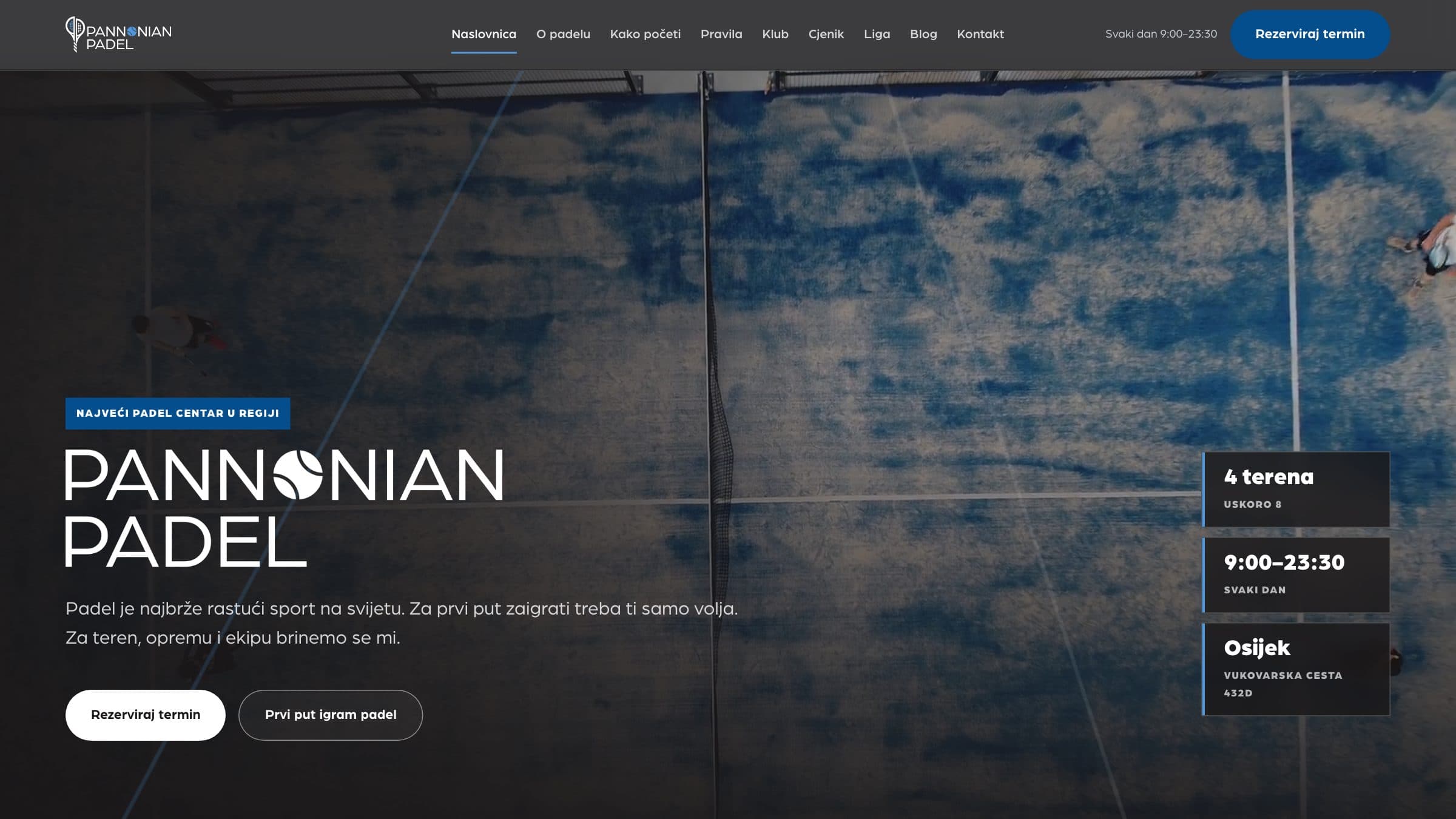
Pannonian Padel screenshot

Case study breakdown

What changed after the build.

Problem

Pannonian Padel, the largest padel center in the region, was doubling its capacity in Osijek -expanding from four courts to eight. Its existing website, built on a hosted site builder, only did one thing well: it introduced the club to people who already knew what padel was. But the club's growth depended on the opposite audience. To fill twice the courts, it had to convince complete beginners, people who had never held a racket, to book a first session. The old site had no story, no obvious path to booking, and a generic template look that could have belonged to any business.

Build

I rebuilt the site from scratch around an acquisition-first narrative. Every section was written to sell the experience rather than list amenities: what a first session actually feels like, how easy it is to start, the social side, and the recovery spa afterwards. The copy speaks directly to a nervous first-timer in a warm, informal voice. A full-bleed hero video draws people in immediately, and one clear booking call to action carries through the whole journey. The design is editorial and asymmetric, premium instead of templated, built around the club's real brand colours and photography.

Technical decisions

Framework-free by design. Plain HTML, CSS, and JavaScript with no build tooling and no dependencies to rot. For a content site this size, that buys near-instant loads, trivial hosting, and a codebase anyone can still maintain in five years.

Owned assets over third-party widgets. I self-hosted the brand font for full control over rendering, and enhanced weak source photos with local AI upscaling. The contact form runs on a small backend with anti-spam protection, so submissions never leave the club's own hosting.

Consent-first analytics. A cookie banner holds all tracking until the visitor agrees, keeping the site clean and compliant by default.

Full production migration. I handled the move to the club's own domain end to end: DNS cutover, redirects, SSL, canonical tags, and search console setup.

Result

The club went live on its own domain with a site that finally matches where the business is heading. It loads fast, reads like a brand instead of a brochure, and gives a first-time visitor one obvious next step: book. The static foundation keeps hosting cheap and maintenance low, and the acquisition-focused copy gives the club a real tool for filling those four new courts.

Next project

Bring the useful part into view.

If your current page hides the proof, slows down the buyer, or makes the next step fuzzy, that is the part I would fix first.

We use cookies for analytics to improve your experience.